
Candidate criticised by China concedes Taipei mayoral race in Taiwan’s local elections
Taiwan’s ruling party candidate has conceded defeat in the Taipei mayoral election as results emerged from local elections across the island’s 22 cities and counties.
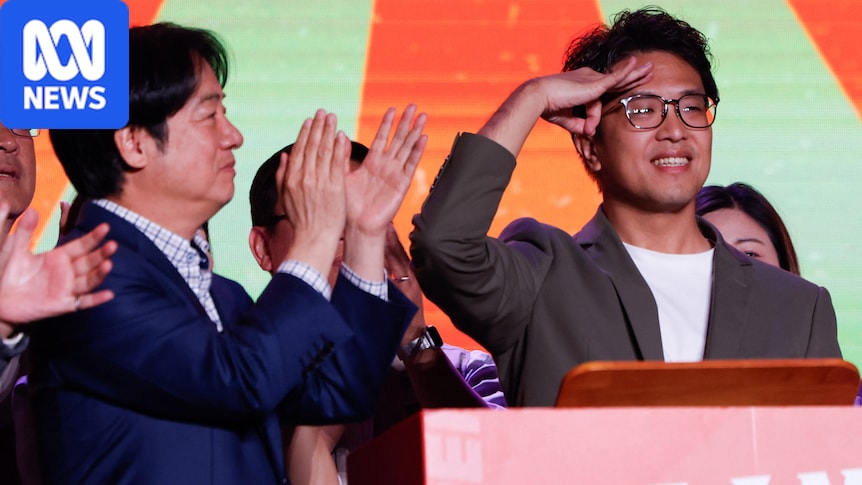
Democratic Progressive Party (DPP) candidate Puma Shen mounted a strong challenge to incumbent Mayor Chiang Wan-an — from the opposition Nationalist Party or Kuomintang (KMT) — but fell short of returning the city to DPP control for the first time since 1994.
“I know there’s many people crying here. I want to thank every person who voted for me,” Mr Shen told thousands of supporters after conceding.
Chiang Wan-an (centre), of the opposition party KMT, at his campaign headquarters. (Reuters: Yu Chih Wei)
Mr Shen, whom Beijing has labelled a separatist, said he had called Mr Chiang to congratulate him.
With votes from 1,606 of 1,790 polling stations counted — or almost 90 per cent — Mr Chiang had about 53.8 per cent of the vote to Mr Shen’s 45.6 per cent, according to the electoral authorities.
The capital has traditionally been a stronghold of the KMT, which favours closer ties with China.
However, the DPP made gains in other local elections on Saturday.
For Taiwan’s six largest cities, the DPP and the KMT won three each and the DPP captured back Taichung, the island’s second-most-populous city, the election results showed.
In total, the DPP won at least nine of Taiwan’s cities and counties, an increase from the five it captured four years ago.
China looms despite focus on local concerns
Unlike presidential elections — when relations with China and Beijing’s pressure on the self-ruled island are major issues — Saturday’s vote focused more on local concerns, including social welfare benefits and other livelihood issues.
But China has not been entirely absent from the debate.
Initially viewed as a long shot, Mr Shen was known for his work organising civil defence courses.
DPP candidate Puma Shen on stage after losing his bid to win the Taipei mayorship in Taipei. (Reuters: Ann Wang)
He gained attention and support while campaigning on issues such as planting more trees and making city government more responsive.
His campaign unfolded amid pressure from Beijing, which imposed sanctions on him and launched an investigation into his activities.
The Chinese government claims Taiwan as its territory and has not ruled out force to annex it.
Taiwanese authorities have accused Beijing of attempting to sow distrust in the island’s electoral system, allegations that Chinese authorities have rejected.
Taiwan’s Ministry of National Defense reported about 33 sorties by Chinese warplanes, including bombers and fighter jets, toward the island between Friday and Saturday.
China’s Taiwan Affairs Office said in a statement on Sunday that it “noted” the election result, adding “mainstream public opinion” in Taiwan wanted peace, development, exchanges and cooperation.
“No matter how Taiwan’s political landscape changes, it cannot alter the direction and trend of cross-Strait relations moving forward, and it cannot stop the historical trend that the motherland must and will inevitably be reunified,” it said.
Taiwan’s government said China should respect its democratic system, the choices of its people, and face the election result pragmatically.
Nuclear power, economy among key issues
In a referendum on Saturday, a majority of Taiwanese voters also cast ballots in favour of overturning a policy that banned nuclear power.
The Central Election Commission said 7.4 million people had cast “yes” ballots to abolish the “nuclear-free homeland” policy, clearing the threshold required for the proposal to pass.
The proposal called for using nuclear energy to boost the economy.
Supporters say additional energy sources are needed to meet the artificial intelligence industry’s growing demand for electricity.
Voter Chang Li-fen said the economy was her foremost concern, but declined to say whom she had voted for.
“If the Taiwan economy is good, only then will people be able to live well,”
she said.
“In France and in Italy, people are protesting because of energy costs, which raised the cost of living, so I think the economy is most important.”
Taiwan’s President Lai Ching-te campaigned for DPP candidates, appearing on Thursday night to support his party’s mayoral candidate in Taoyuan City.
Candidates held rallies on Friday in a last-minute bid for votes.
Mr Shen travelled in a motorcade across the city, stopping for 15 minutes at a time to greet the crowds of supporters.
Mr Chiang held a Friday night rally with other KMT city council members, with supporters waving balloons, flags and light-up sticks to cheer him on.
AP/Reuters
Source: www.abc.net.au